Zoysiagrass Lawns L 395
- Summary
- Full Text
- Related
Authors
Gil W. Landry, Extension Agronomist - Turf
Freddie Clinton Waltz, Extension Specialist - Turfgrass
Availability
Published on Oct 12, 2010.
Summary
Zoysiagrasses are warm-season turfgrasses that are becoming more popular throughout Georgia and the southeastern United States. Like all warm-season turfgrasses, zoysiagrass is green in summer and brown or dormant in winter. An established, well-maintained zoysiagrass will make a very dense and attractive lawn. This publication discusses zoysiagrass lawns.
Publication Full Text
Zoysiagrass Lawns
Zoysiagrasses are warm-season turfgrasses that are becoming more popular throughout Georgia and the southeastern United States. Like all warm-season turfgrasses, zoysiagrass is green in summer and brown or dormant in winter. An established, well-maintained zoysiagrass will make a very dense and attractive lawn. Most zoysiagrasses are slower growing than other warm-season grasses and thus can be very low maintenance. Most zoysiagrasses, however, also need more water than other warm-season turfgrasses to maintain proper growth during dry periods of spring and summer.
Zoysiagrass grows well on many different soil types and at different soil pH levels. Some cultivars are second only to St. Augustinegrass in shade tolerance. In fact, in the Piedmont area (northern third) of Georgia, zoysia is one of the best choices for shady conditions. Zoysiagrasses have good cold tolerance for a warm-season grass, and their straw color during winter dormancy is more attractive than other grasses. The zoysiagrasses have rhizomes and stolons that allow them to grow into bare soil areas and form a dense turf that helps resist weed invasion. The zoysiagrasses also have excellent salt tolerance and wear resistance. Once established, the slow growth rate and relative low nitrogen requirement can result in less mowing.
The zoysiagrasses, like all turfgrasses, are not without some disadvantages. Most cultivars are extremely slow to establish. When planted by plugs or sprigs, often more than one growing season is needed for complete soil coverage. The zoysiagrasses generally need more water than bermudagrass or centipedegrass to maintain active, green growth. The zoysiagrasses may develop excessive thatch layers, especially when over-fertilized with nitrogen, and their high shoot density and stiff leaves can make mowing difficult. Since the zoysiagrasses have a slow rate of growth, recovery from damage is very slow, and common bermudagrass encroachment can become a problem. Finally, the zoysiagrasses are not as tolerant to postemergence herbicides, flooding or nematode infestations as are bermudagrasses.
Cultivars
Several species and/or cultivars of zoysiagrasses are available in Georgia. They vary widely in color, leaf texture (width) and growth rate. The availability of even the most common cultivars can be limited.
Emerald zoysiagrass (Zoysia japonica X Z. tenuifolia) was developed in Tifton, Georgia, and has a dark green color, a very fine leaf texture, good shade tolerance, high shoot and rhizome density, and low growth habit. 'Emerald' will develop excess thatch rather quickly and its poor cold tolerance makes it more susceptible to winter injury in and north of the Atlanta area.
Meyer zoysiagrass, also called Z-52, is an improved cultivar of Zoysia japonica. It has a medium, dark-green color and intermediate leaf texture and shoot density. 'Meyer' is slightly less shade tolerant than 'Emerald.' It also has the fastest spring greenup and is the most cold tolerant zoysiagrass. It is grown as far north as Pennsylvania and Missouri. This is the zoysiagrass cultivar often advertised as the "super" grass in newspapers and magazines. These advertising claims are true in part, but they do not tell the entire story. 'Meyer' has lower rhizome density than 'Emerald' and has the other disadvantages mentioned earlier.
El Toro is another improved Zoysia japonica recently developed in California; it looks like 'Meyer.' 'El Toro' is the fastest growing zoysiagrass, which makes it quick to establish. It has low rhizome development, however, like 'Meyer.' It produces less thatch and, because of its softer leaf, has better tolerance to mowing with a rotary mower. 'El Toro' also has excellent resistance to rust, a common disease of zoysiagrass in Georgia.
Other less common zoysiagrasses in Georgia include the following:
Zoysia matrella or manilagrass, is intermediate in leaf texture, shoot density, low temperature hardiness, and low temperature color retention between 'Emerald' and 'Meyer' zoysiagrass.
Empire zoysia is from Brazil. It has broader leaves and is more aggressive than 'Meyer' or 'El Toro.' The variety may be mowed with a standard rotary mower.
Empress zoysia is from Brazil. It has coarser leaves than 'Emerald' but finer than 'Meyer.'
J-36 is a seed propagated variety that has medium dark-green color, medium density and coarse texture.
Zenith is a seeded zoysia that has medium dark-green color and medium density. It has finer texture than 'El Toro' but coarser than 'Meyer' and 'Emerald.'
Zeon is vegetatively produced and very similar to 'Emerald' because of its similar leaf texture and density. It is slightly less green and has softer leaves than 'Emerald.'
There are many seeded, common types of zoysiagrass. Examples include Japanese or Korean lawn grass or Korean common zoysiagrass. Most have a coarse leaf texture like tall fescue, light green color, intermediate shoot density and excellent cold tolerance. Recently, many other seeded types for which there is very little per-formance information are being marketed. Seed availability is limited, however, and they must be pretreated with KOH and light.
Establishment
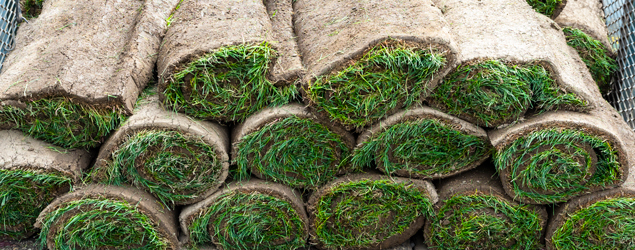
Most of the zoysiagrasses must be planted vegetatively with sod, plugs or sprigs. Sod can be planted at any time; problems, however, are more frequent with sod laid from November through March because of winter weather. The best time to plug or sprig zoysiagrass is in May and June. April planting generally results in more weed problems, and July or later plantings need more water and are more prone to winter injury.
Purchase plant material that is "certified" as to its varietal purity and freedom from noxious weeds. This provides assurance of high quality plant material and is identified by a blue tag. The blue certification tag identifies the species, cultivar, quantity of grass and date of harvest; it includes specific identification numbers.
Soil Preparation
Proper soil preparation is the key to successful establishment of a turfgrass. Bermudagrass and other weeds that are hard to control, such as nutsedge, should be treated with a herbicide before planting. Deep cultivation by plowing or rototilling 6 to 8 inches deep is very important to establishing and maintaining a healthy turf. After completing initial preparation and properly leveling the area, collect a soil sample to obtain soil fertilizer recommendations. A common establishment recommendation is to incorporate 25 pounds of 5-10-15 fertilizer per 1,000 square feet into the top 4 to 6 inches of soil prior to planting. Rake or harrow the area to smooth the surface before planting.
Sodding
Sodding is the most expensive method of establishment, but it also provides an "instant" lawn. Wet the soil surface thoroughly after preparation. Place the sod tightly together to avoid cracks; irrigate thoroughly and roll to ensure good sod-to-soil contact. Apply about ¼ inch of water daily until the sod is well rooted into the soil before beginning more normal irrigation practices. Upon establishment, apply a preemergence herbicide after sodding if the area is expected to produce a severe weed problem.
Sprigging and Plugging
Planting with sprigs and/or plugs generally requires more time and labor than seeding. Plant runners (stolons or rhizomes) in rows that are 6 inches apart. Plant the sprigs end-to-end in the row, cover about 1 or 2 inches deep but leave of the sprig exposed to light. Rolling can be used to press sprigs into the soil for good contact. The soil must be kept moist until plants initiate new growth and until the lawn is completely covered.
Plugging is the planting of small square or circular pieces of sod. Plugs are cut from the sod and placed into holes the same size as the plug. Plant plugs no more than 6 inches apart and space rows every 6 inches. Press the plugs firmly into the soil. The grass and soil should be kept moist until the grass is well rooted. Begin mowing at a height of 1 inch when the grass reaches a height of 1½ inches. Be sure the mower blades are sharp and do not mow when the grass and/or soil are wet. Applying a preemergence herbicide according to label directions after planting will help eliminate weed competition.
Seeding
The normal zoysiagrass seeding rate is 1 to 2 pounds per 1,000 square feet. Spread the seed evenly using a mechanical spreader. Divide the seed into two equal parts and spread half in one direction and the other half at a right angle to the first direction (Figure 1). Rake or drag the soil to cover the seed to a depth of about ¼ inch. Then roll the area with a light-weight roller to ensure good seed/soil contact.
Applying one bale per 1,000 square feet of a straw mulch helps retain soil moisture for more rapid germination and reduces soil erosion.
The seed must be kept moist, so daily, light irrigations are needed for the first three weeks. Germination should occur in two weeks if the seeds are kept moist. As the seedlings develop, decrease the irrigation frequency and increase the amount of water applied until normal practices can be followed. The area should completely cover in six to eight weeks if properly maintained. Begin mowing at a height of 1 inch when the seedlings reach a height of 1½ inches. Be sure the mower's blades are sharp, and do not mow when the grass and/or soil is wet. Weedy grasses, like crabgrass and goosegrass, can be controlled in the second year with applications of preemergence herbicides.
Maintenance
FertilizationA fertilization program should be based on soil test analyses. High rates of fertilizer, especially nitrogen, will produce a dark green turf, but will also lead to growth problems such as bermudagrass encroachment or excess thatch. Two to three pounds of nitrogen per 1,000 square feet per year is generally good for zoysiagrass. The 3-pound rate may be preferable on sandy soils. Apply the nitrogen in split applications. The first application should be made during spring greenup, and again in mid and/or late summer. Determine phosphorus and potassium needs by soil testing. If soil testing is not used, a general purpose fertilizer with a 3-1-2 nitrogen-phosphorus-potassium (N-P2O5-K2O) ratio such as 12-4-8 is good. Apply 8 pounds of 12-4-8 per 1,000 square feet during spring greenup, and again in mid and/or late summer. Another possible choice of fertilizer is 6 pounds of 16-4-8 per 1,000 square feet. Apply the fertilizer evenly over the area when the grass leaves are dry. Use a mechanical spreader and use the two direction application procedure as described for seeding (Figure 1).
Mowing
Proper mowing is also very important to maintaining healthy, attractive turf. Zoysiagrass should be mowed between the height on 1/2 inch to 1½ inches. A reel mower provides better appearance, especially at low mowing heights; however, rotary mowers with sharp blades are most often used. As a general rule, never remove more than of the leaf tissue at any one mowing. High and infrequent mowing tends to encourage thatch development and scalping. During periods of moisture stress, or in shaded areas, raise the mowing height about ½ inch. Most zoysiagrasses do not tolerate scalping as well as bermudagrass.
Irrigation
Irrigating mature turf areas should be on an "as-needed" basis. Irrigate only when the grass shows signs of moisture stress such as a dull bluish-grey color, rolling leaves or wilt. Apply enough water to thoroughly wet the soil to a depth of 6 to 8 inches. Irrigation at night has little effect on disease development and is the most efficient time to irrigate.
Figure 2.Thatch
Zoysiagrass stolons and rhizomes are tough and decay slowly. Infrequent mowing, over-fertilization and over-irrigating lead to excess thatch buildup. Once these living and dead plant parts build into a layer, thatch is formed (Figure 2). When this thatch layer exceeds ½ inch, problems arise. Thatch reduces water movement and encourages shallow rooting that requires more frequent irrigation. It also harbors insects and disease organisms and often results in winter injury.
Removing excess thatch is generally a gradual process that may be done either before spring greenup or between greenup and the summer dry period in July. The most effective way to control thatch is by topdressing. This involves spreading a thin layer (¼") of clean topsoil over the turf surface. The most practical method of thatch control is by using vertical mowers, aerifiers, power rakes or other dethatching equipment. Generally, one pass over the lawn area is enough. A power rake usually is a spring tined device and is not effective on Zoysiagrass. The key is to discourage thatch development by avoiding improper mowing, fertilization, and irrigation.
Pest Problems
A dense, healthy turf obtained through proper fertilization, mowing and watering is the best defense against pest problems. However, when problems arise from unwanted weeds, diseases, or insects, control is dependent upon proper pest identification and treatment.
Brown patch, rust and dollar spot diseases can cause problems in zoysiagrass that may require fungicides for control. However, cultural prac-tices such as proper irrigation and increased nitrogen for rust and dollar spot control are often enough. For brown patch, it is best to avoid improper irrigation and nitrogen application until the weather changes. White grubs can be a major insect pest in zoysiagrass. Examining the soil underlying the turf in late summer and early fall is the best method for monitoring this insect. In some parts of the country, chinch bugs are a serious problem during dry years in hot spots such as south-facing slopes and along concrete walks and drives. Nematodes, soil-borne microscopic worms, are reported to be very damaging to zoysiagrass. Areas with heavy infestations will continue to show severe wilt after watering and will not respond to applications of nitrogen.
Contact your local county extension office for assistance and appropriate publications if you suspect pest problems.
Originally prepared by Gil Landry, Jr., Extension Turf Specialist
L 395 |
Published
on
Oct 12, 2010.
The University of Georgia and Ft. Valley State University, the U.S. Department of Agriculture and counties of the state cooperating.
The Cooperative Extension Service, the University of Georgia College of Agricultural and Environmental Sciences offers educational programs,
assistance and materials to all people without regard to race, color, national origin, age, sex or disability.
An Equal Opportunity Employer/Affirmative Action Organization Committed to a Diverse Work Force
Figure 1.