
- Sintim, Henry Yabbey
Revitalizing Degraded Soils
Summary
Regenerative agricultural practices and composite application of soil amendments and inoculants could help revitalize soil health, reduce fertilizer use, and enhance the sustainability and profitability of row crop production in Georgia.
Situation
Ultisols, the most common soil type in Georgia, are highly weathered soils with low organic matter and poor native fertility. The subtropical climate in the state causes intense weathering of primary minerals and rapid decomposition of organic matter and crop residues. Thus, the soil has low resilience, and a slight change in environmental conditions can adversely impact food and fiber production. Moreover, the poor native fertility of the soils makes fertilizer a major input cost because of the need to supply ample nutrients to sustain plant health.
Response
Long-term soil health projects have been established at different locations to assess the performance of various regenerative agricultural practices and how they can be seamlessly integrated into existing cropping systems. Additional efforts were made to optimize some of the practices, including formulating soil amendments that will enhance the efficacy of soil inoculants. A special research topic on “Innovative Agricultural Practices to Improve Soil Health and Sustain Food Production” was edited in the journal Frontiers in Sustainable Food Systems to publish manuscripts on emerging agricultural practices. Also, a USDA-FSA grant proposal with a $1 million budget was submitted (led by Dr. Puneet Dwivedi) to help grower adoption of conservation agricultural practices.
Impact
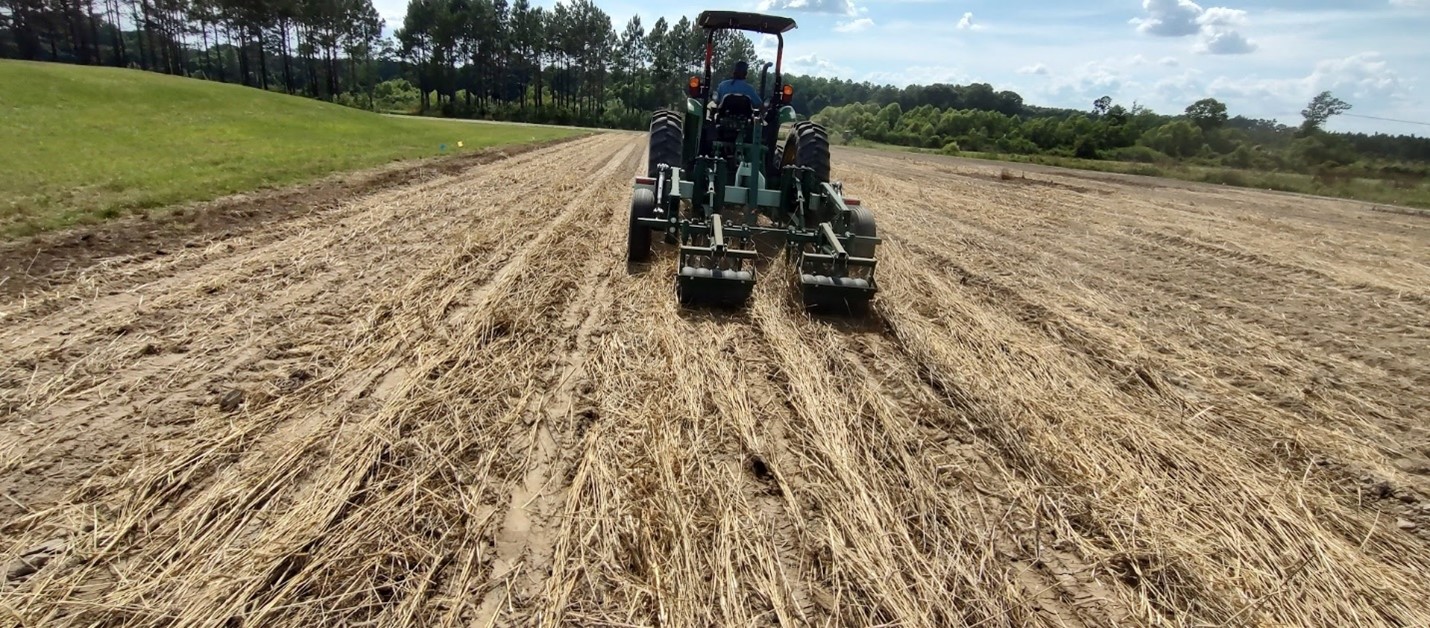
We have observed improved soil health conditions with the continual application of poultry litter as a soil amendment. Combining poultry litter application with strip-tillage operation resulted in minimal yield reduction. The slight reduction in yield was likely due to short-term soil compaction of transitioning to the strip-tillage. Both strip-tillage and poultry litter will reduce the production cost for growers. The formulated products enhanced the productivity of corn and cotton that were assessed. Research on corn conducted at the UGA Tifton campus showed an average yield of 248 bu/ac when the products were applied, compared to 221 bu/ac yield when they were not applied. Also, five on-farm corn trials were established, and the products led to higher corn yields at the various locations (ranging from 2.9 to 6.8% increase), except at one location where the yield was lower (by 0.6%). Cotton research conducted at the UGA experiment station in Camilla showed an average yield increase of 11% when the products were applied. Noticeable results at the Camilla site were the yields when no fertilizer was applied. Under no fertilizer application condition, applying the products resulted in 862 lbs/ac lint yield, compared to 609 lbs/ac lint yield when the products were not applied, which translates to a yield increase of 41.5%. A gin turnout of 38% was used to calculate the yield because the cotton was harvested on October 27, 2023, and it has not yet been ginned. In general, differences in gin turnout are marginal so the trend of the results is expected to be the same after the actual ginned data is used. More studies on cotton were conducted at the UGA Tifton Campus, with obvious visible differences noticed, but the plots have not yet been harvested. Using corn price of $4.5/bu and cotton price of $0.8/lb, the amendment could potentially have a $77.3 million economic impact in Georgia every year if the cost is assumed to be $12/ac. The actual production cost is less than $6/ac depending on production size. The estimations were based on 350,000 acres of corn and 1.2 million acres of cotton, as well as an average yield increase of 6 bu/ac for corn and 90 lbs/ac for cotton. The estimations are conservative as a much higher yield response could be obtained and the need to reduce fertilizer input has not been accounted for. The special topic edited in the journal Frontiers in Sustainable Food Systems has gained a lot of interest with wide readership and downloads all over the world (3,923 downloads and 23,000 reads by October 28, 2023). The special topic can be accessed at the following link. We expect it to be useful to scientists, agricultural educators, government regulators, and other relevant stakeholders. The USDA-FSA grant proposal has been approved for funding, which will be used to help foster grower adoption of conservation agricultural practices for improved soil health and resilience of cropping systems. https://www.frontiersin.org/research-topics/18716/innovative-agricultural-practices-to-improve-soil-health-and-sustain-food-production
State Issue
Sustainability, Conservation, & the Environment
Details
- Year: 2023
- Geographic Scope: State
- County: Tift
- Location: College Station, Athens
-
Program Areas:
- Agriculture & Natural Resources

Lorem ipsum dolor sit amet, consectetur adipisicing elit, sed do eiusmod tempor incididunt ut labore et dolore magna aliqua.
Download Image
Author
Collaborator(s)
CAES Collaborator(s)
- Habteselassie, Mussie
Non-CAES Collaborator(s)
- Dwivedi, Puneet
Research Impact